Your funnel, in your CMS.
A NexusFunnel funnel also runs inside WordPress, TYPO3 or JTL-Shop, on the website’s own domain. Leads, uploads and metrics then live in that system’s database. There is no back channel to NexusFunnel.
How the funnel gets into the system.
You export a published funnel as a ZIP and upload it in the plugin. The plugin checks the package against its schema and shows an import report. Nothing is overwritten silently. When a new version arrives later, it replaces HTML and templates, never the data.
The rules for validating submissions, storing events, deleting uploads and computing metrics live in one shared PHP library. The three plugins are thin adapters on top of it. That is why they compute the same numbers as NexusFunnel itself.
funnel-bewerbung-pflege-v3.zip
+-- funnel.yaml            Vertrag zwischen Export und Wirtssystem
+-- funnel.html            das Contract-Fragment, bereinigt und geprüft
+-- runtime/
|   +-- nf-runtime.js      SDK, Version festgepinnt
|   +-- nf-runtime.css
+-- assets/                Bilder, Schriften, Stile, nichts Externes
+-- emails/                Vorlagen für Betreiber und Bestätigung
+-- schema/
|   +-- funnel.schema.json JSON-Schema der YAML
+-- README.md              erzeugt aus YAML und Schema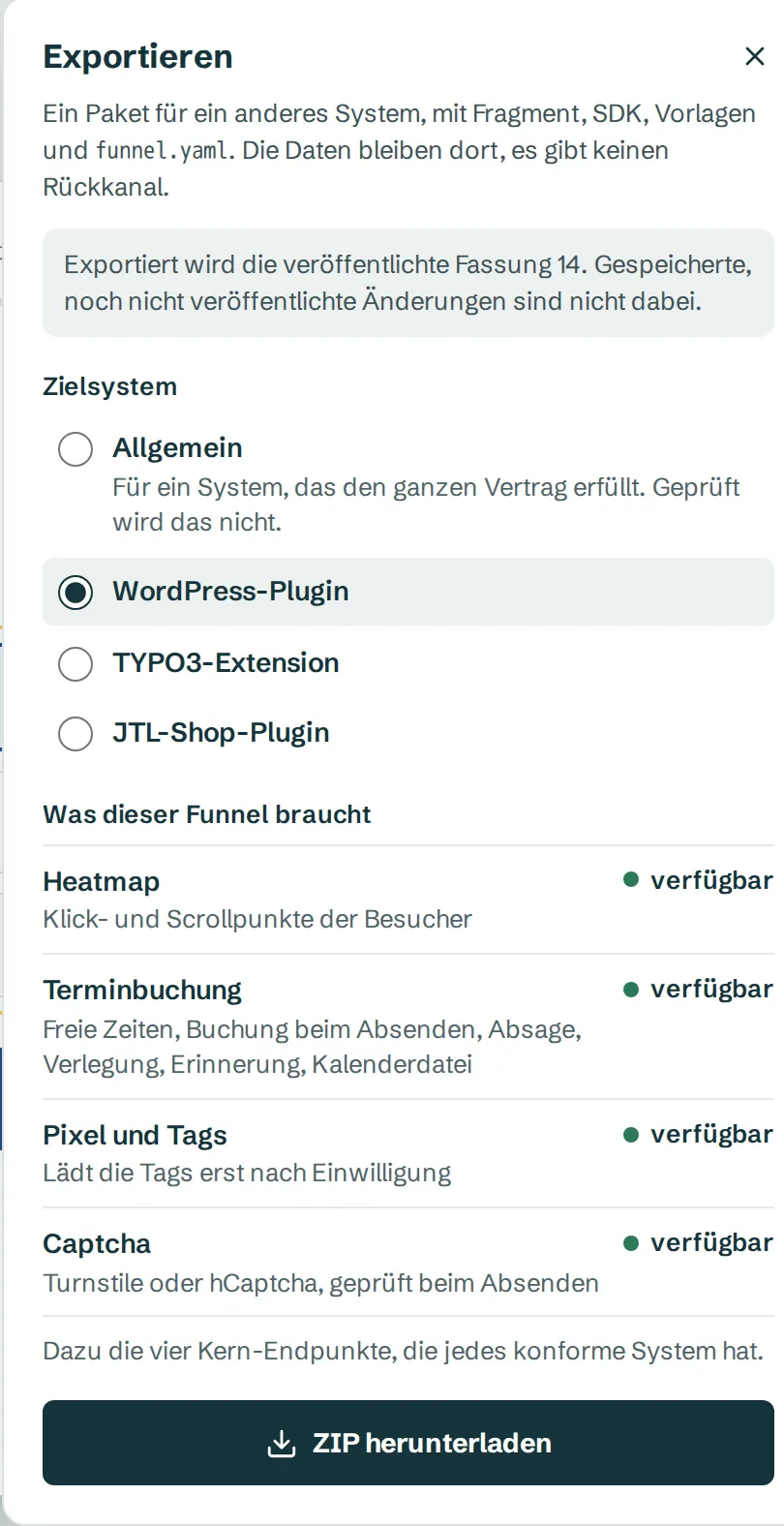
Three systems, each tested against the real one.
Every plugin has to pass the same conformance suite: it sends a reference funnel through all endpoints, checks the stored data, moves the clock forward, checks deletion and recomputes the metrics. The reference funnel deliberately carries bait such as straight quotes, smileys and template syntax: whatever a system changes in the HTML shows up there.
- WordPress 6
- Own post type, the shortcode
[nexusfunnel slug="…"]and a block. Own tables for submissions, events and uploads, mail viawp_mail, scheduling via WP-Cron, an admin page with funnel view and lead list. - TYPO3 13.4
- Extension with a content element, middleware for the endpoints, own tables, a backend module for metrics, mail via TYPO3, scheduling via the scheduler.
- JTL-Shop 5.8
- Plugin with an OPC portlet, own tables, an admin tab for metrics, mail via the JTL mailer, scheduling via JTL cron. Tested against a real JTL-Shop 5.8.0, not a stub.
Since September 2026 all three can also take bookings and verify a captcha. Other systems such as Shopware or Joomla are not available.
Getting them, and the licence.
The plugins are free and licensed under the GPL. They are not yet listed in the WordPress.org, TYPO3 or JTL directories. Support and updates for websites without an account with us are on the pricing page.
The export package contains everything the funnel needs. A funnel inside a plugin loads nothing from our servers or anyone else’s.
Measured.
| What | Result | How it was measured | As of |
|---|---|---|---|
| Plugin conformance | WordPress 68, JTL 68, TYPO3 88, all passed | WordPress 6, TYPO3 13.4 and JTL-Shop 5.8.0, each in a container running the real system, including counter-checks against the running system | 2026-11-28 |
The sandbox is built and goes online soon.
A separate instance to try things out: one click, no sign-up, two sample funnels with metrics, wiped every night. Until it is online, the demo page shows what to expect.