Your design, not our block kit.
NexusFunnel is a funnel builder in which every step is a piece of HTML. You design it in the builder, import it from Lovable or let your AI write it. You run it on your own server or inside WordPress, TYPO3 and JTL-Shop.
Hosted from €32 a month, self-hosted from €790 one-off. Plugins are free.
- Self-hosted or hosted
- WordPress · TYPO3 · JTL-Shop
- Claude, ChatGPT, Cursor via MCP
- No cookie before consent
<section data-nf-step="baujahr" data-nf-title="Baujahr" hidden>
  <h2 id="frage-baujahr">Wann wurde Ihr Haus gebaut?</h2>
  <p>Das Baujahr verrät uns viel über die Dämmung. Ungefähr reicht.</p>
  <div class="kacheln" data-nf-choice="baujahr" data-nf-label="Baujahr"
       data-nf-required role="group" aria-labelledby="frage-baujahr">
    <button type="button" data-nf-value="vor-1978">vor 1978</button>
    <button type="button" data-nf-value="1978-1994">1978 bis 1994</button>
    <button type="button" data-nf-value="1995-2009">1995 bis 2009</button>
    <button type="button" data-nf-value="ab-2010">ab 2010</button>
    <button type="button" data-nf-value="unbekannt">Weiß ich nicht</button>
  </div>
  <p data-nf-error="baujahr" role="alert"></p>
</section>
Highlighted is what the SDK wires up: the tiles advance as soon as one is picked, the answer is required, and error messages go into the empty paragraph. Everything else is ordinary HTML, with your classes and your CSS.
Every step is HTML. That is the whole idea.
A block kit stores your funnel as a list of its own blocks, and whatever its catalogue does not know cannot be done. NexusFunnel stores the HTML itself. Behaviour is added through data-nf-* attributes. So there is only one way a funnel is served, no matter who wrote it:
- The builder
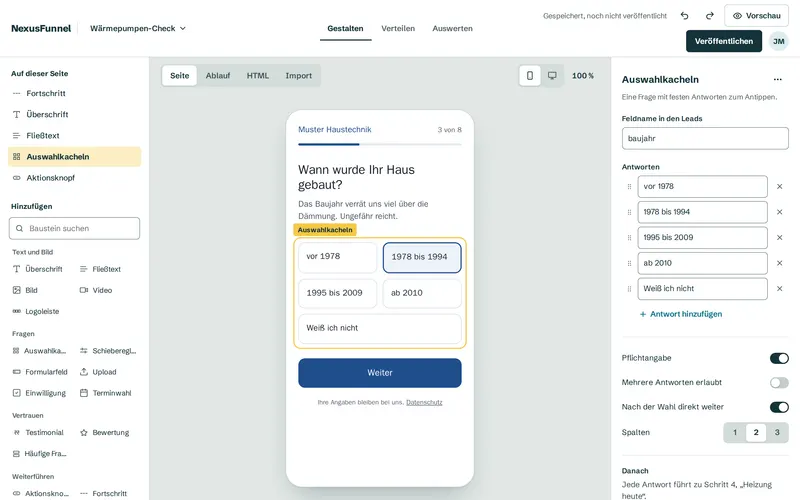
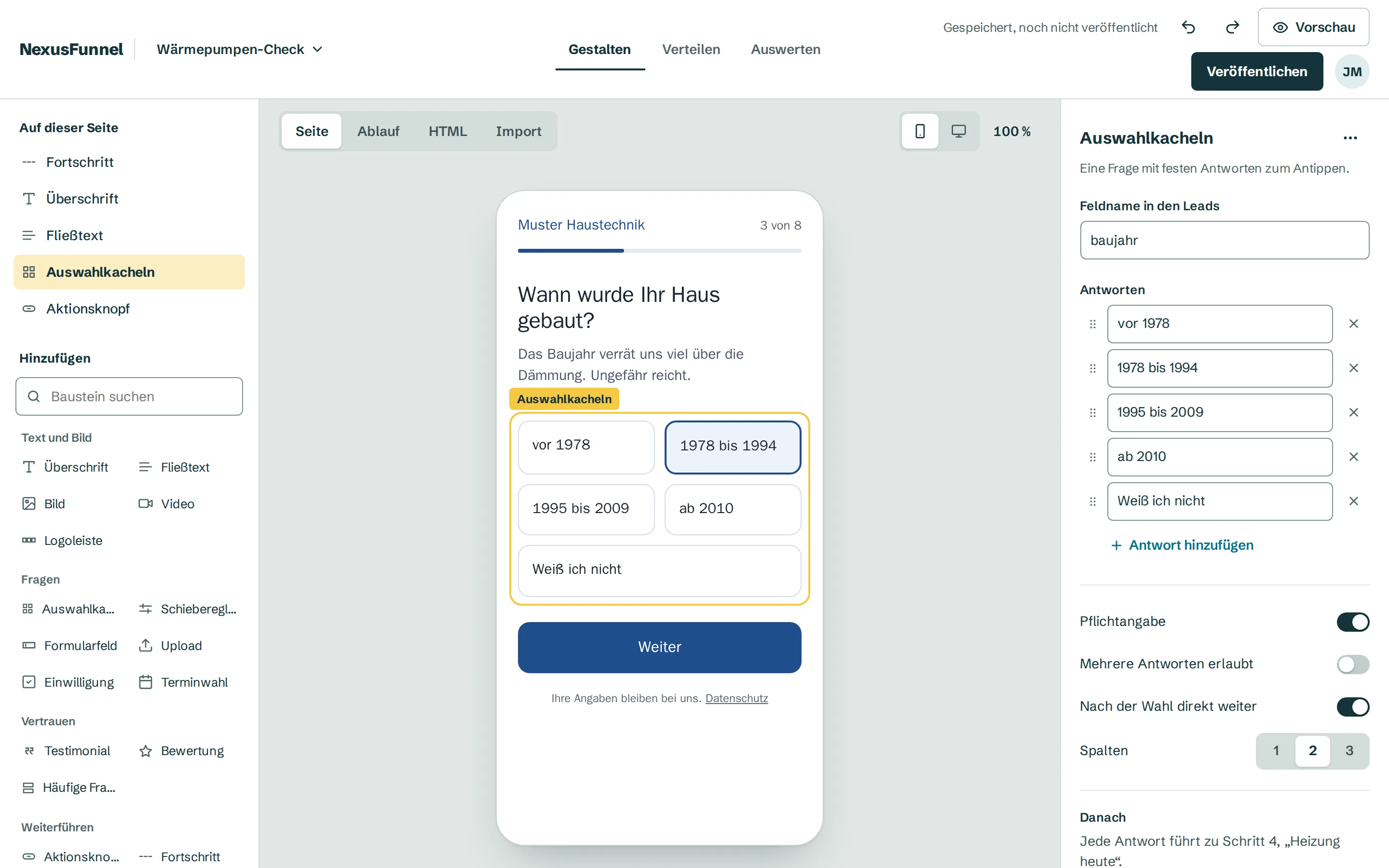
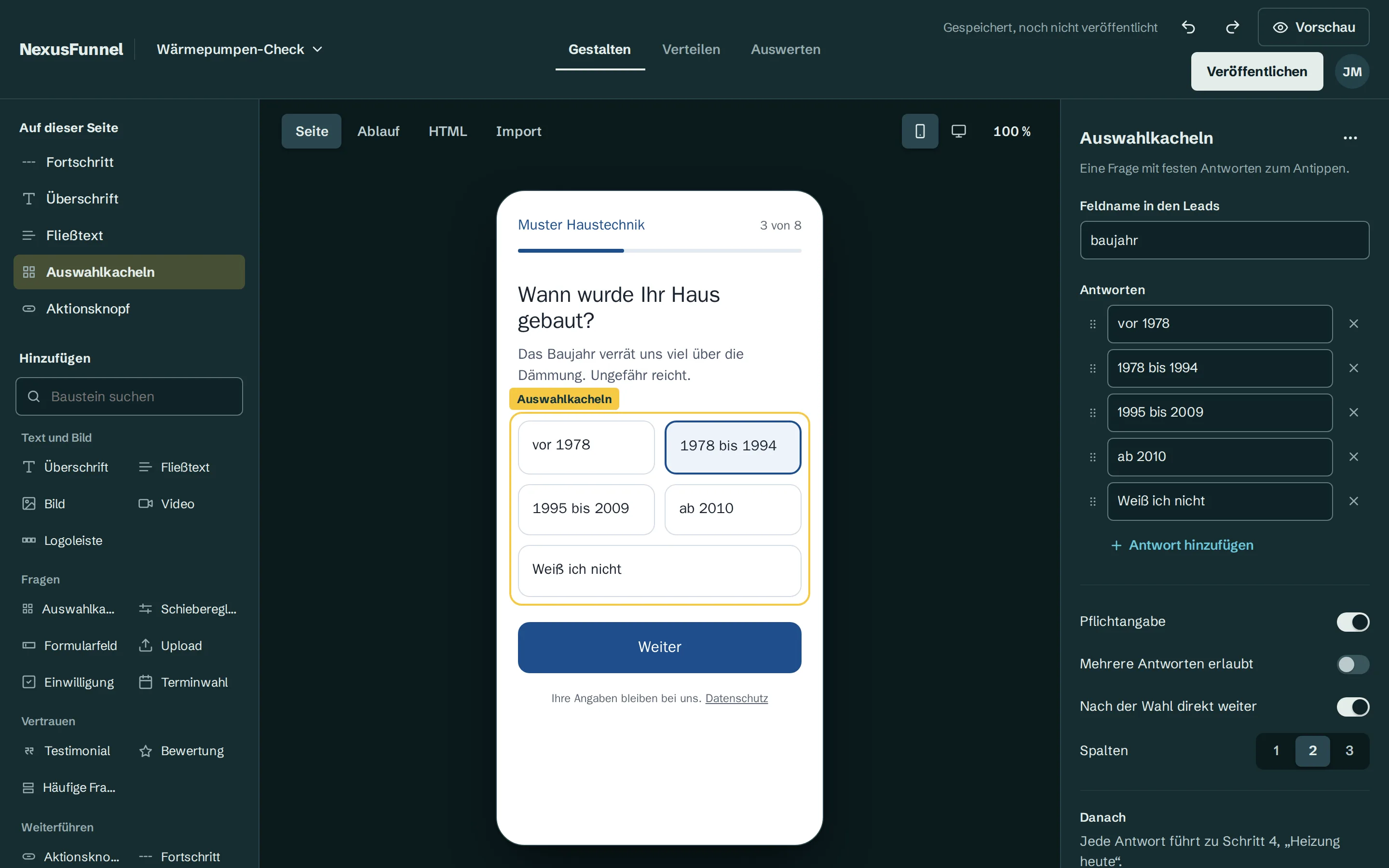
- Works with named blocks: choice tiles, form fields, upload, booking, countdown, testimonials and more. Phone and desktop previews are there before anything is published.
- The import
- A Lovable export with several linked pages becomes a funnel with one step per page. Brand fonts, SVG logo and your own video are kept. What the import does
- Your AI
- Creates funnels as drafts through the MCP server and validates them against the same rules as the builder. How the connection works
The price: HTML from elsewhere is cleaned before it is stored. Scripts, embedded frames and calls to third-party servers stay out.
Runs on your server or in your CMS.
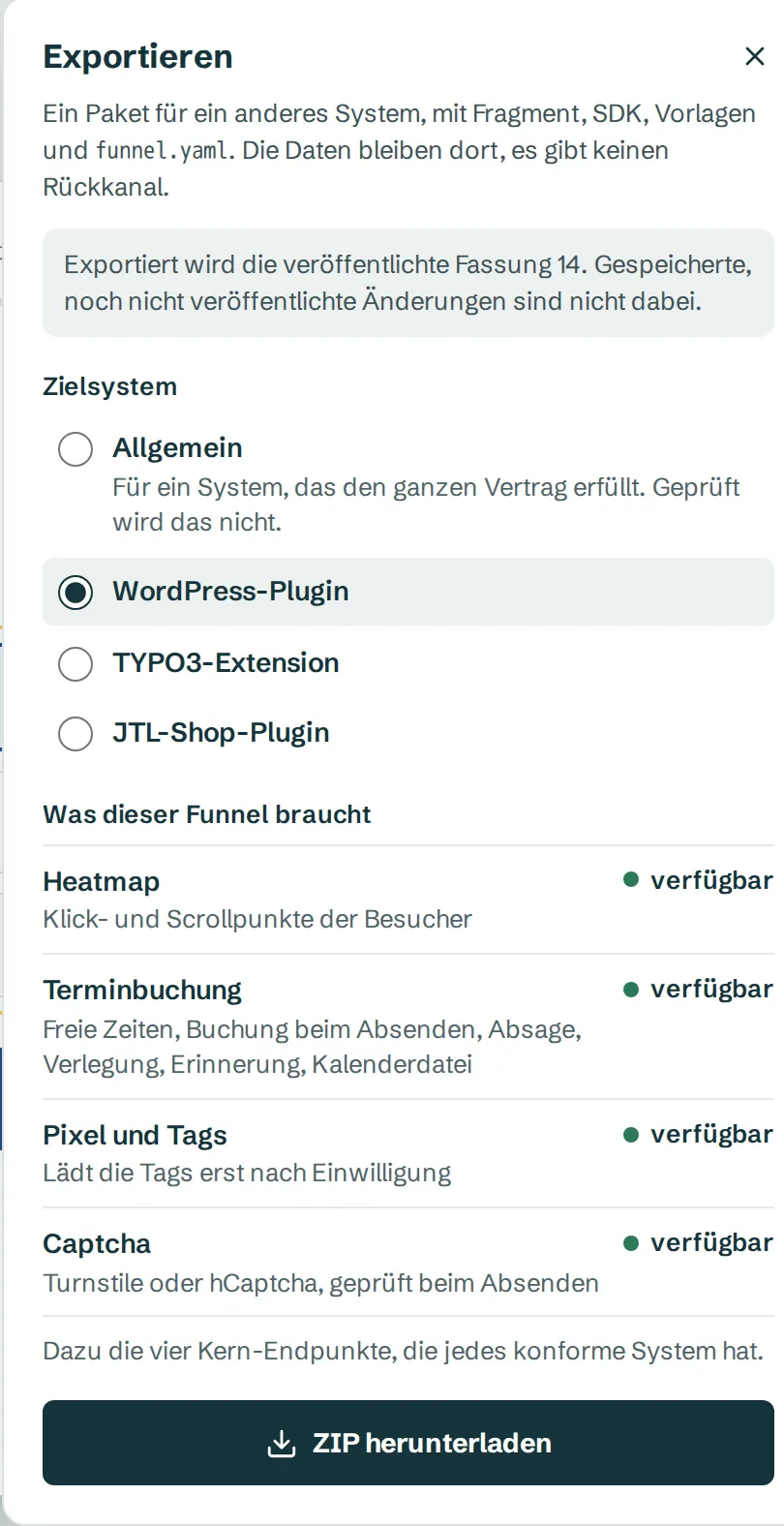
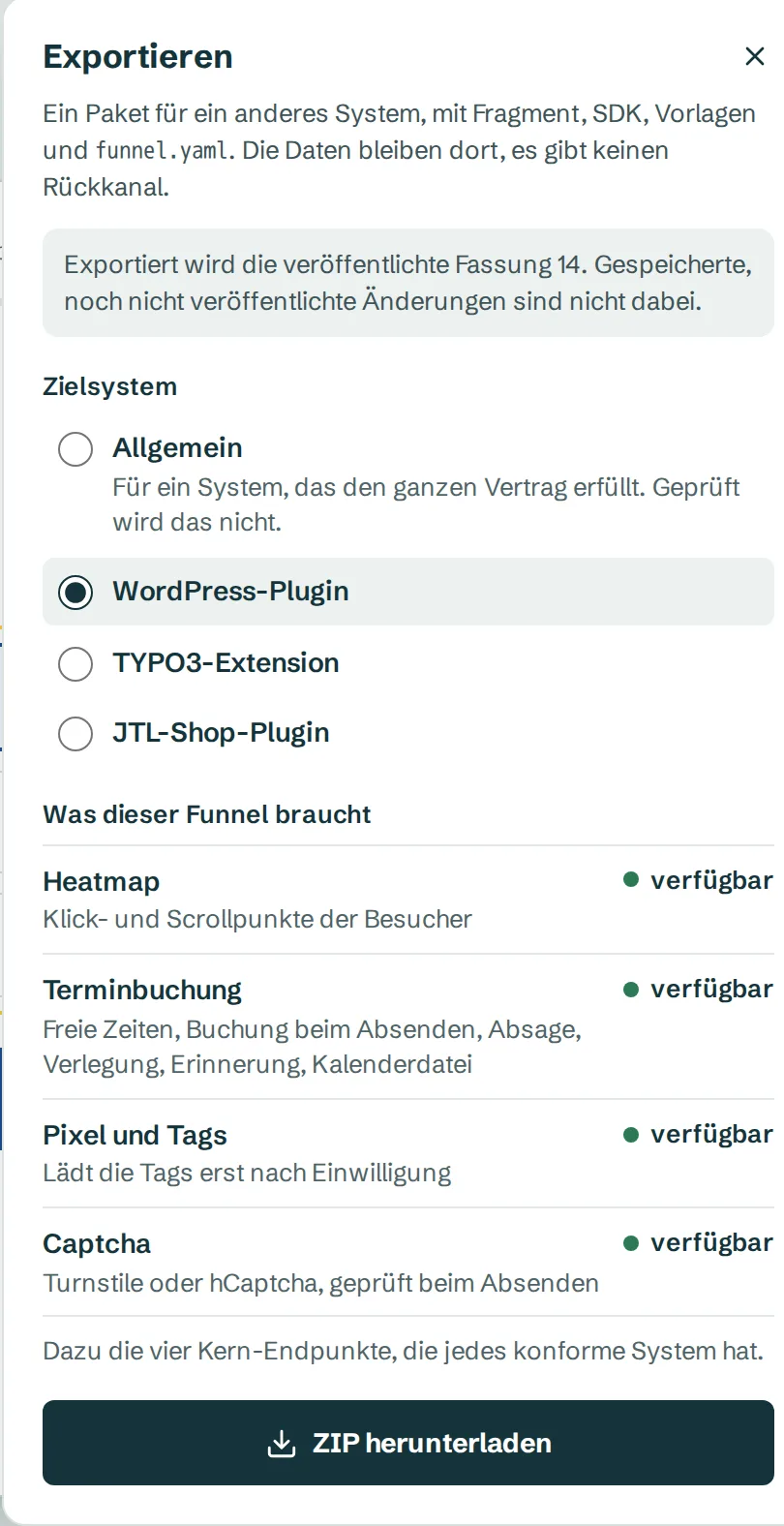
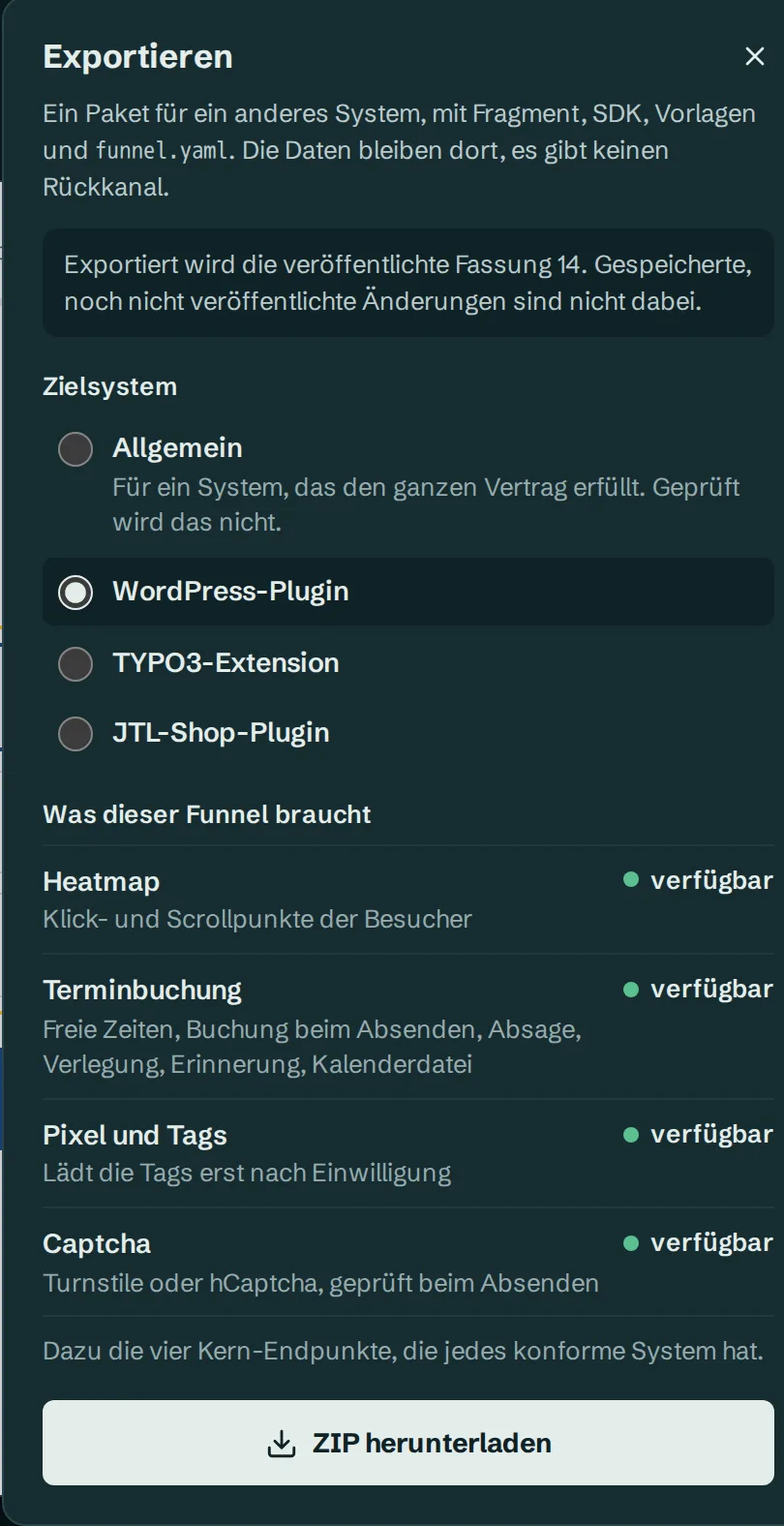
You run NexusFunnel yourself, as a Docker stack or on ordinary PHP web space with FTP access and a cron entry. From launch you can also have us run it. A finished funnel can also run as a package inside WordPress, TYPO3 or JTL-Shop.
In a plugin, leads, uploads and metrics live in the host system’s database. There is no back channel to us. Each plugin passes its full conformance suite, each in a container against the real system: WordPress and JTL-Shop 68 tests each, TYPO3 88.
A published funnel loads nothing from third-party servers. Pixels and tags load only after consent, and telemetry to us is not something you switch off: it does not exist.
Your AI writes the same HTML.
NexusFunnel has an MCP server. Claude, ChatGPT, Cursor or Claude Code create funnels through it. Clients such as claude.ai sign themselves in via OAuth once you agree on a consent screen.
The model does not fill in a block schema; it writes HTML like the example above, with your design. It gets the rules from the server itself, through the nf_get_guide tool. Every draft goes through the same validator as in the builder.
An AI connection creates, edits, validates and reads metrics. It does not publish, read submissions or delete anything. That stays with you, in the browser.
And if the visitor brings an AI?
A published funnel can offer its steps as tools, through WebMCP. The AI agent in your visitor’s browser then picks answers and fills in fields instead of guessing where to click. Consent is still given only by the person, with a click. Sessions run by an agent are shown separately in the metrics and do not count in A/B tests. It is off by default, because WebMCP is still a trial in Chrome.
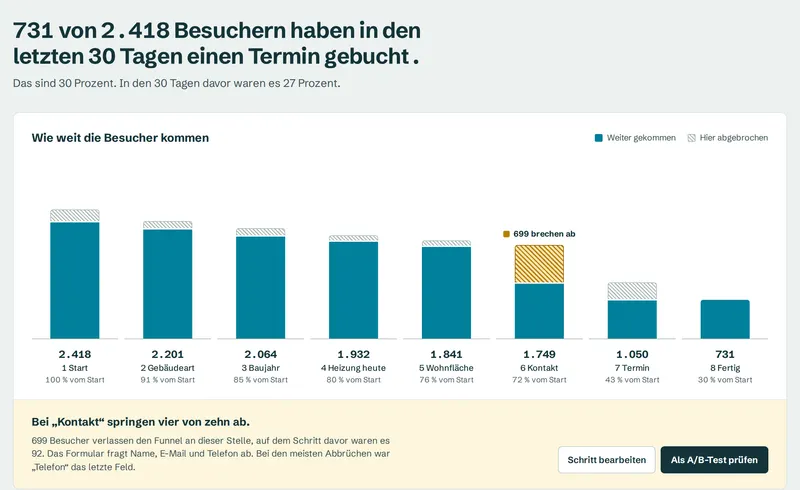
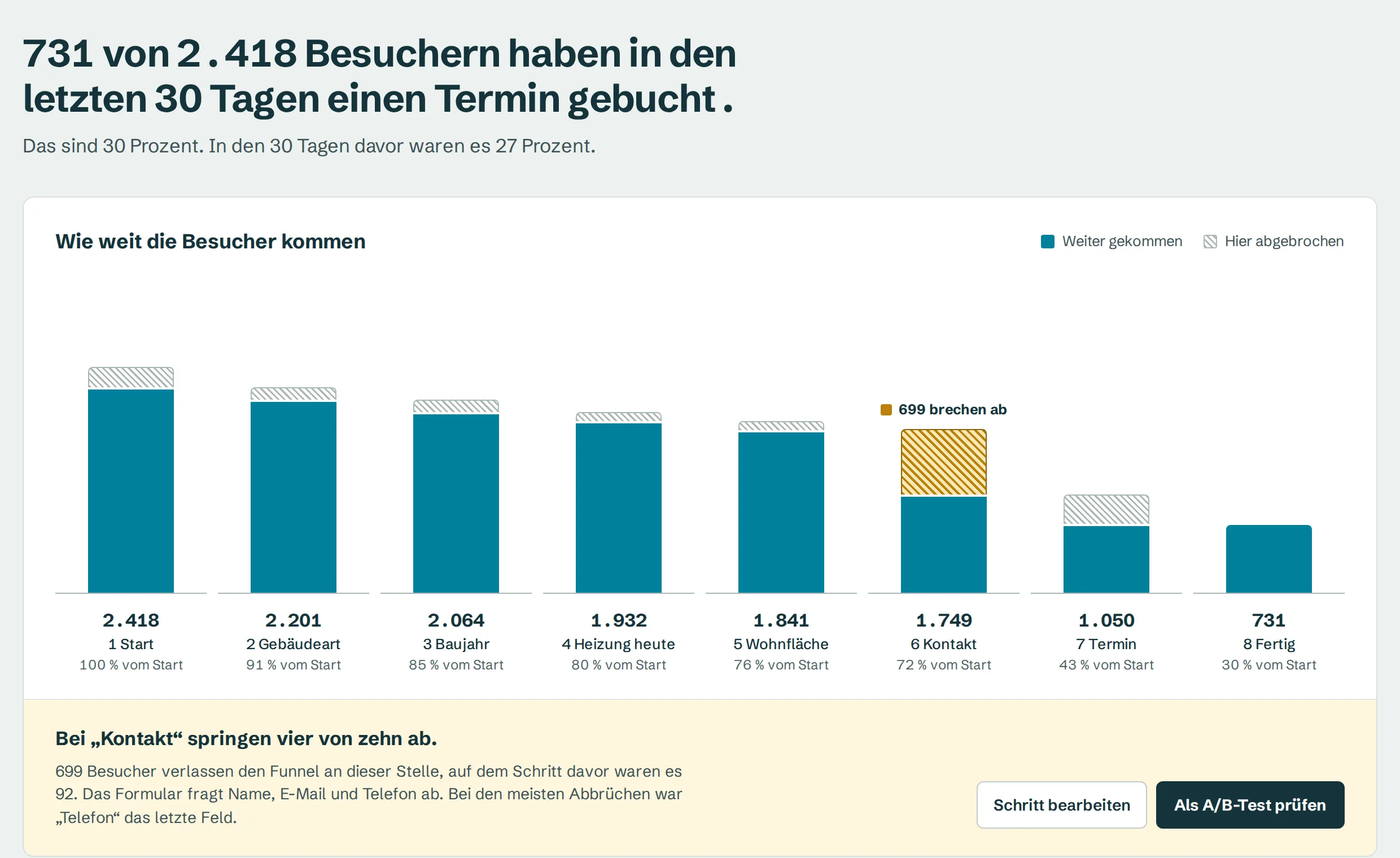
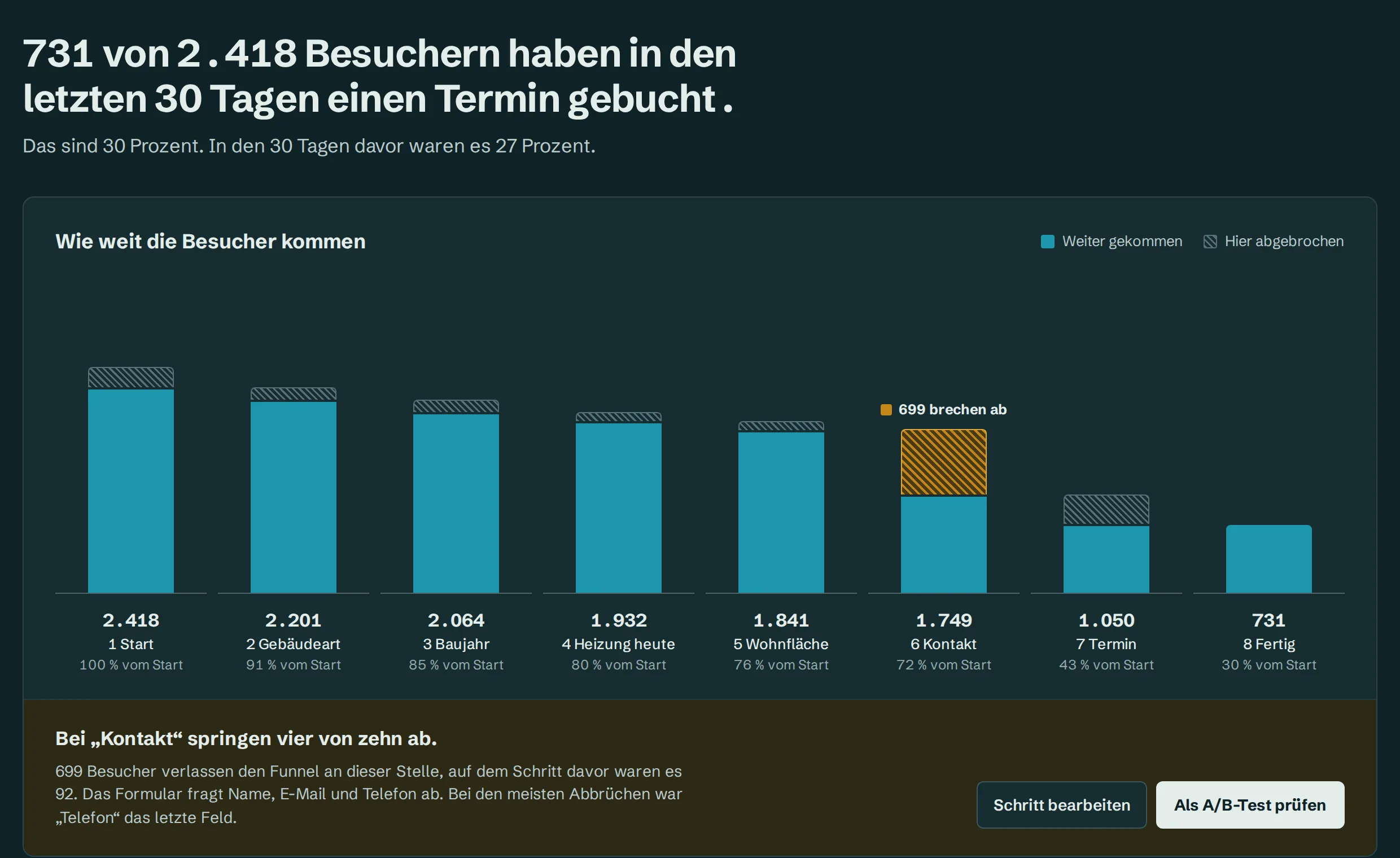
You see which field makes visitors give up.
Every step shows how many people reached it, how many left there and how long they stayed. On top of that comes the field most often filled in last before people left. It tells you which question drives them away.
Only a stored submission counts as a lead. A click on the WhatsApp button is not a conversion; it is a metric of its own.
Who it fits, and who it does not.
It fits if you
- build funnels for clients and each one should look different, not like a block kit’s template.
- collect leads in the EU and do not want visitor data sitting with a third-party provider.
- have a site on WordPress, TYPO3 or JTL-Shop and want the funnel to run there.
- design pages with Lovable or an AI and want funnels with metrics out of them.
It does not fit if you
- want to take payments inside the funnel. There is no payment processing.
- are looking for courses, membership areas or newsletters. NexusFunnel does funnels, not a platform around them.
- never want to see HTML. The builder does a lot for you, but under the hood everything is HTML.
Hosted from €32 a month, self-hosted from €790 one-off. Plugins are free.
Measured, with dates.
The figures on this site come from acceptance test runs. Where a run has a limit, it is stated next to it.
| What | Result | How it was measured | As of |
|---|---|---|---|
| Loading the metrics of a funnel with 100,000 events | 329 ms median | Performance test against MariaDB 11.4, 5,000 sessions, limit 500 ms | 2026-09-11 |
| Delivery with 100 concurrent visitors | 120 ms median, p95 227 ms | Production stack, 0 errors in 700 requests, 800 of 800 events stored | 2026-09-14 |
| Plugin conformance | WordPress 68, JTL 68, TYPO3 88, all passed | WordPress 6, TYPO3 13.4 and JTL-Shop 5.8.0, each in a container running the real system, including counter-checks against the running system | 2026-11-28 |
| Accessibility of the funnel templates | 0 violations | axe, WCAG 2 A/AA, 54 checks across every step including branches and error states | 2026-09-14 |
| First real customer package imported from Lovable | 12 steps, 7 fields, 0 errors | 12 linked HTML pages; visual comparison per page 0.03 to 0.28 % differing pixels | 2026-09-17 |
| AI model writes valid HTML on the first attempt | 10 of 10 tasks | Claude Code with Sonnet, no prior knowledge, MCP tools only. Before the fix: 3 of 10. Repeated on 2026-11-27 after the extension to 17 tools, again 10 of 10. The same tasks that drove the fix, so not an independent figure | 2026-09-10 |
| MCP server checked against the protocol | 239 checks, 0 failures | Revisions 2026-07-28, 2025-11-25, 2025-06-18 and older, over HTTP and through the stdio bridge; no real outside client is connected in this run | 2026-11-28 |
The sandbox is built and goes online soon.
A separate instance to try things out: one click, no sign-up, two sample funnels with metrics, wiped every night. Until it is online, the demo page shows what to expect.